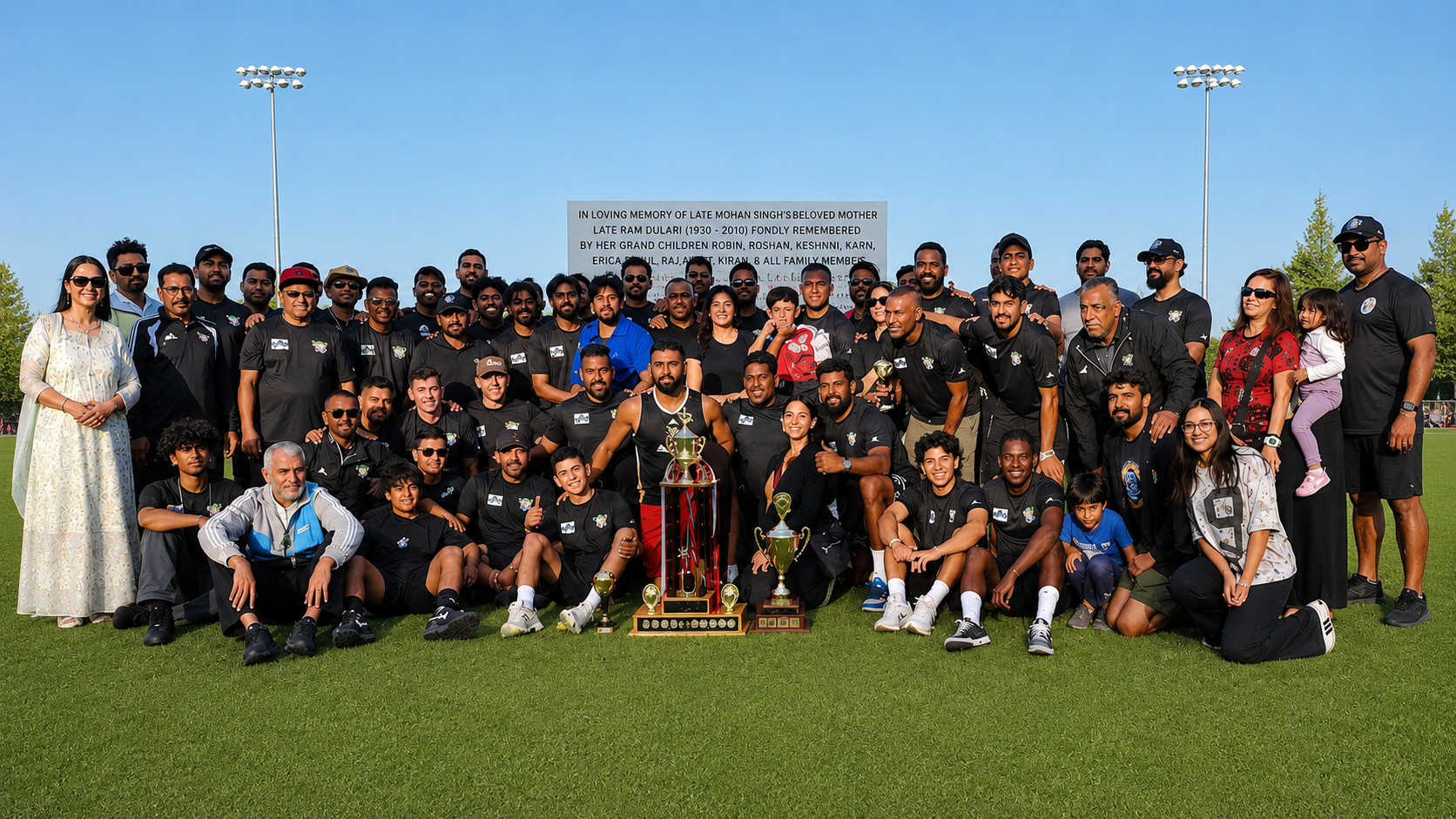

WITH the Dulari Cup now behind us for another year, the success of the two-day event continues to be the talking point among the Fijian football community.
Two years ago, the Singh family of Calgary, Alberta, took a leap of faith by relocating the tournament to Vancouver.
It was a bold decision that has paid off handsomely.
Since its inception in 1985, the tournament, and organized in memory of Mohan Singh’s mother, Ram Dulari, has grown beyond expectations.
What began as a few team tournament, has evolved into one of the most anticipated summer event for Fijians, attracting quality teams, supporters, sponsors and stakeholders.
Today, the Dulari Cup is more than just a football tournament.
It has become a celebration of Fijian culture, forming the centrepiece of one of the biggest summer festivals in British Columbia through its partnership with the Fiji Expo.
The success raises an important question.
If one family can successfully organize and grow a tournament of this magnitude, what is stopping local football administrators or the Fiji League from creating a truly inclusive tournament that brings together clubs from across Canada and beyond?
Rich history
The blueprint already exists.
Back in the 1990s and early 2000s, Fijian tournaments such as the Inter-District Championship (IDC) and Battle of the Giants (BOG) in Canada regularly attracted thousands of supporters.
Under visionary leadership of, Sikandar Khan, late Azad Khan, Chris Khan, Jay Narayan, Vince Lal and others tournaments flourished without the benefit of partnerships with major cultural festivals.
Fans came in droves because football was competitive, rivalries endless and those that ran the teams were professional, and there was genuine pride for footballers in representing their districts.
Proper Planning
The Dulari Cup has shown that those proper planing still matter today.
One of the biggest reasons behind its success has been the organisers’ willingness to engage in meaningful discussions, and invest.
Attractive prize money has drawn quality teams from Canada, United States and New Zealand, raising the standard of competition and giving players something meaningful to compete for.
Equally important has been the tournament’s professional presentation, and welcoming atmosphere for teams and families.
The appetite for Fijian football is clearly there.
Supporters have shown they will travel, sponsors have shown they are willing to invest, and players have demonstrated they want to compete in well-run events.
The challenge now is for others to build on that momentum.
A unified tournament involving clubs from across Canada and beyond could once again become a marquee event on the Fijian sporting calendar.
The Dulari Cup has proved that success is not about luck.
It comes from vision and a willingness to invest in the football community.
The opportunity now exists for others to follow that example.
The next big thing
The tournament that has the potential to bring the glory days of football on the lower mainland is the Jayden and Jordan celebration of life football tournament.
The Prasad family (Bob) has been organizing the tournament for over 4-years, and the distinctive is its hospitality, where everyone receives a complimentary lunch and beverages.
The modest size event have people who not only understand the sport but also played it, their passion could see future growth.
The tournament would be built by and for the community and proudly represent British Columbia.