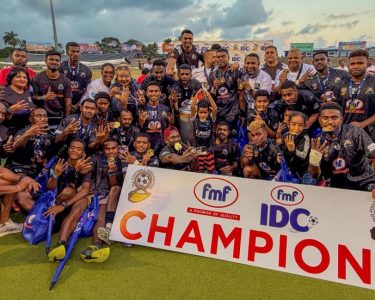

THE story of FANCA did not began in a stadium, nor at a formal federation meeting, but around a family gathering in Nakurakura, Nadi.
It was in 1994, during a family function, Azad Khan, his uncle Kalandar Khan and cousin Gul Zaman discussed an idea that seemed ambitious, inviting overseas teams to Fiji to participate in the Fiji Muslim Sports Association’s upcoming Golden Jubilee (1995) celebrations.
That conversation would become the first major step towards what is the FANCA Federation today, one of the biggest Fiji Muslim sporting traditions.
The ‘idea’ was presented to then-Fiji Muslim Sports Association secretary, Mohammed Sattar, who initially had reservations.
“The inclusion was both convincing and deserving,” he revealed to SportsOne.
“But was against our constitution to allow overseas teams to play in the all-Fijian tournament.
“With the Golden Jubilee, the men had made a strong submission, one that certainly got our president at the time, Azam Khan’s attention.”
A leap of faith
A series of meetings followed.
Mindful of the contributions former Fijians had made to the FMSA and the wider football community, Sattar said Azam Khan, gave a careful consideration before agreeing to include Canada, New Zealand, Australia and the United States.
But only on a condition.
That the overseas teams would play a parallel tournament as part of the Golden Jubilee celebrations, with the winner earning the right to face the Fijian champion in a one-off grand final for the Golden Jubilee championship.
New Zealand, Australia, Canada and the United States competed in a round-robin tournament at Prince Charles Park in Nadi.
Rewa won the Fiji championship and faced the United States of America (USA) who eventually defeated Rewa 2-1 to claim the Golden Jubilee championship.
The birth of an idea
The success of the Golden Jubilee went beyond football played on the field.
Following the closing ceremony, delegates met to discuss the possibility of establishing a new Five Nations tournament.
For Azad Khan, Kalandar Khan, Gul Zaman, it was a defining moment.
“A fruitful meeting. A new tournament was endorsed. Overseas and regional delegates wholeheartedly supported what it was all about, bringing people together through sports.”
Five Nations Games
While vetting for a venue was underway, British Columbia Muslim Sports Association president Chris Khan unilaterally announced that Vancouver, Canada was willing to host the inaugural Five Nations tournament in 1997.
The birth of FANCA
Ahead of the 1997 tournament, that was dubbed the ‘Vancouver Games’ chairperson Azad Khan proposed that the acronym FANCA Federation, representing Fiji, Australia, New Zealand, Canada and America become the official name of the tournament.
The proposal was unanimously adopted, along with the first constitution, which was ratified by the board.
“It was enacted that FANCA be a biennial event,” Sattar said.
The constitution was subsequently revamped, including provisions concerning player eligibility, membership, permanent status, elections and portfolios.
Five nations, one vision
Fiji, Australia, New Zealand, Canada and the United States of America fielded teams combining youth and experience for the inaugural FANCA tournament.
The three-day event attracted thousands of spectators.
Day One was played at Coquitlam’s Town Centre Stadium before the tournament moved to Queen’s Park Stadium in New Westminster for Day Two.
The action then returned to Coquitlam Town Centre for the grand finale.
Canada made a strong start, defeating Fiji 1-0 in the opening match.
The two sides met again in the final.
This time, Fiji responded.
Fiji defeated Canada 2-1 to become the inaugural FANCA champions.
A biennial tradition
What began as an ambitious idea at a family gathering in Nakurakura during preparations for Golden Jubilee developed into a biennial international football tradition.
Over the years, every participating nation has hosted the tournament and, with the exception of the United States of America , every nation has won the championship.
COVID-19 suspension
The 2020 FANCA tournament was cancelled because of the COVID-19 pandemic, with health measures and international travel restrictions making it impossible to stage the event.
Traditionally, FANCA has become one of the biggest Fiji Muslim football events, if not the biggest, creating a tremendous atmosphere both on and off the field.
Its appeal extends beyond football, bringing together players, families and the wider community from across the participating nations.
The visionaries behind FANCA
For what FANCA has become, it is important to remember those who were ahead of their time, people whose ideas, vision and determination helped create something that has endured for decades.
Had it not been for that conversation in ‘Nakurakura’ overseas teams may never have been included in the Golden Jubilee celebrations.
And without that initial leap of faith, the Five Nations tournament may never have evolved into the FANCA Federation that exists today.
2026 FANCA Nations Muslim World Cup
This year’s tournament coincides with the centennial celebration of the Fiji Muslim League, marking 100 years since its establishment in 1926.
The 2026 FANCA Nations Muslim World Cup has taken on a festival-like atmosphere, with football joined by netball, golf and volleyball, involving hundreds of athletes from across the participating nations.
The idea first discussed at that Nakurakura family gathering more than three decades ago is still alive.
Tribute to the pioneers
Azad Khan, Chris Khan and Kalandar Khan of Canada, Abdul Hamid of Fiji, and Liakat Ali Khan of the United States of America have since passed away.
But they left behind more than memories.
They left a lasting legacy in FANCA, a federation born from a simple idea of bringing people together through football, community and friendship.
Their leap of faith in 1995 became the foundation of a tradition that continues to connect generations of footballers and families across nations.