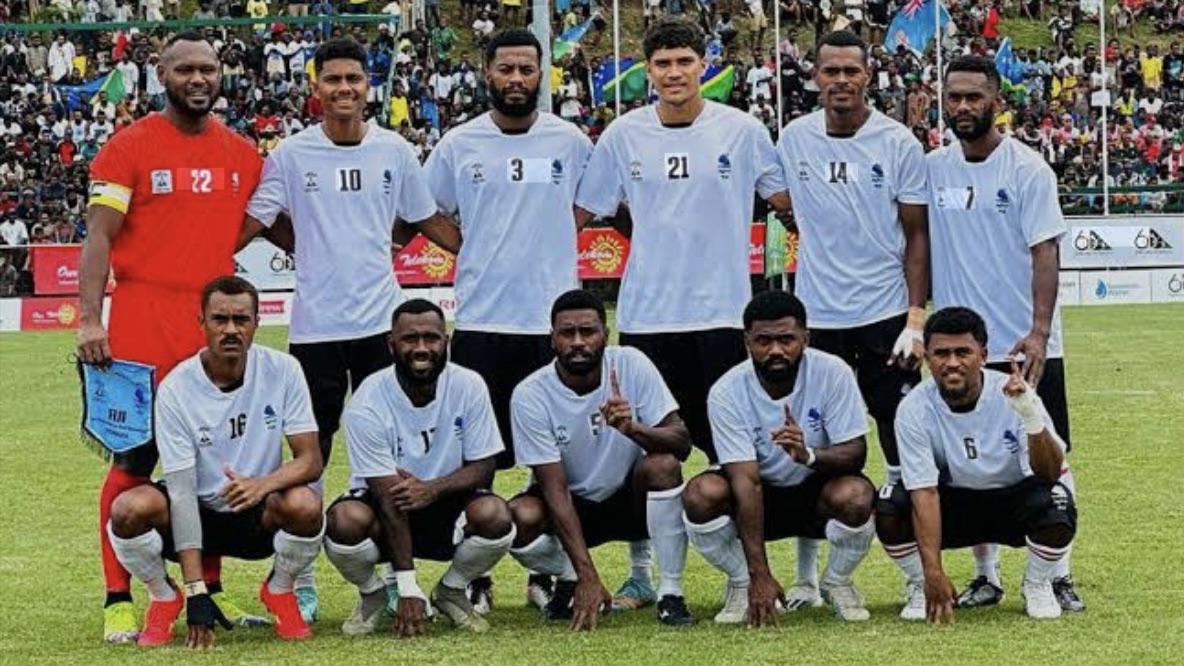

AS the football world continues to marvel the FIFA World Cup, one question continues to linger for Fijian fans.
Will Fiji ever be part of football’s greatest spectacle?
The World Cup showcases not only the game’s elite but also inspiring underdog stories.
Nations with limited resources and small populations arrive believing they belong.
Look no further than Cape Verde, a country of barely 500,000 people.
The footballing world expected them to simply make up the numbers.
But, they earned global admiration with fearless performances, even giving reigning world champions Argentina a tough challenge, proving that, football is a team sport and takes eleven players to compete.
That is what makes Fiji’s absence even more frustrating.
Great footballers
Over the decades, Fiji has produced great footballers who were capable of competing with the best in Oceania and the world.
The national team of the 1980s remains one of the country’s finest, built around outstanding players such as Josaia Tubuna, Abdul Mannan, Meli Vuilabasa, Kelemedi Vosuga, Savenaca Waqa, Abraham Watkins and Ivor Evans.
That side achieved memorable victories over New Zealand and Australia in international friendlies.
Yet when it came to the FIFA World Cup qualifiers, Fiji repeatedly fell short, suffering heavy defeats, including losses by double-digit margins against stronger opposition.
The 1990s and early 2000s ushered in another talented generation led by Esala Masi, Radike Nawalu, Ravuama Madigi, Osea Vakatalesau and Tagi Vonolagi.
They inspired hope but were unable to lift Fiji into genuine World Cup contention.
The years that followed produced perhaps Fiji’s most recognisable footballer in Roy Krishna.
Much of the country’s international ambition rested on his shoulders.
But with him and those around him, Fiji failed to make it out of Oceania Zone.
And now his tenure coming to an end, who is the next big name or names.
That is where Fiji continues to struggle.
Modern Football
The modern World Cup has shown that success is no longer determined by population size.
Curaçao and Cape Verde have demonstrated that smart planning, including outside players with roots to the country help develop modern football and overcome limitations.
Raw talent–mindset
For Fiji, the problem has never been about shortage of talent.
What it lacks is a long-term football strategy that survives beyond election cycles and administrative agendas.
Until the game is driven by a genuine football minds, one centred on player development, coaching excellence, and strong governance, qualifying for the World Cup will remain an aspiration rather than a realistic objective.
The World Cup should not simply be something Fijians watch on television.
But genuinely believes it can one day be part of.